
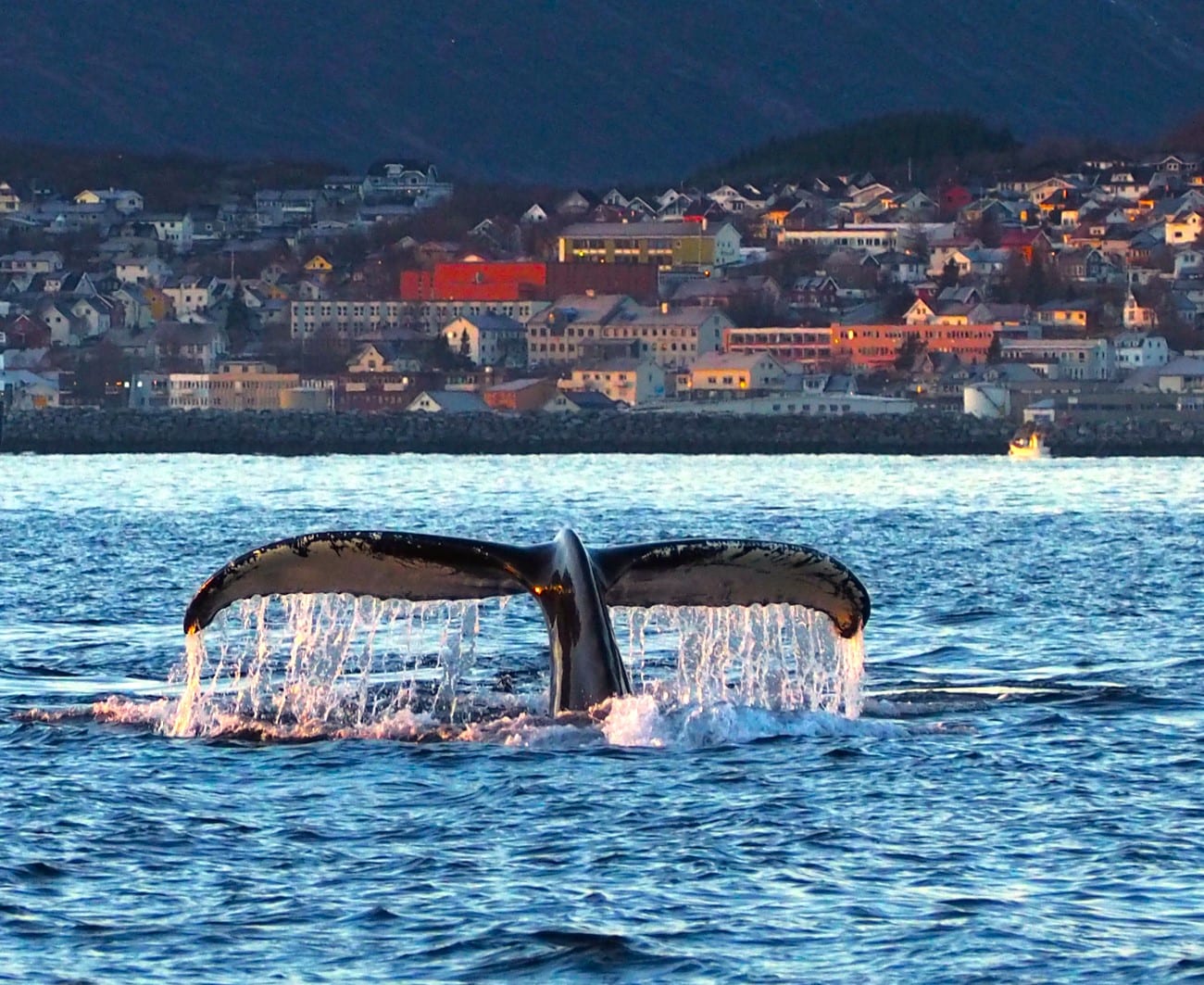
Quick answer
Yes — you can join whale tours that depart directly from Skjervøy Havn at Havnegata 18, so guests already on the island skip the long Tromsø daytrip. Entry to the harbour is free (0 NOK); the tours themselves require booking. Sailings run in the winter herring season, when humpbacks and orcas move into the surrounding fjords.
Between late autumn and midwinter, the fjords around Skjervøy fill with herring, and the herring draw humpback whales and orcas in by the hundred. The island shifts from a quiet fishing port into one of the more reliable feeding grounds in Arctic Norway, and the boats that follow the shoals leave from the same quay the trawlers use. That proximity is the whole reason planning whale watching from skjervoy rewards anyone already sleeping on the island rather than commuting to reach the water. The decision most guests face becomes obvious the moment they open a map. Coaches and organised trips from Tromsø cover long distances before they reach waters that sit only minutes from Skjervøy Havn. A local hvalsafari fra Skjervøy skips that transfer, trading a pre-dawn bus for a short walk to the pier on Havnegata. The harbour itself costs nothing to enter; the vessels are what require booking, whether a fast RIB or a larger, steadier sightseeing hull. Conditions here are genuinely Arctic, and honesty about that matters. Daylight runs thin through the core season, the water stays cold, and sightings depend on where the herring settle rather than any fixed timetable. Skippers read the fjord system around Kvænangen day by day, so no two departures trace the same route. What a Skjervøy whale safari trades certainty for is speed of access — less time in transit leaves more room to launch when circling sea eagles and surface splashing signal that the whales are close. None of this replaces the specifics. Exact meeting points, the strongest months, what to wear, and how each vessel is reserved all sit in the dedicated sections further down. The narrative here only frames the choice. For visitors who deliberately based themselves on the island, joining a local departure is usually the shorter, calmer approach to whale watching from skjervoy than any daytrip built around the Tromsø crowds.
“For guests already based on the island, a local departure is the shorter, calmer route to the water than any daytrip aimed at the Tromsø crowds.”
Comparing Whale Watching From Skjervoy vs. Tromsø Daytrips
Visitors staying in Skjervøy must decide whether to book a direct local departure from the harbor or purchase a full-day tour package originating in Tromsø.
|
Top pick Local Departure from Skjervøy Direct harbor start |
Tromsø Daytrip Package Roundtrip transit included | |
|---|---|---|
| Departure Point | Skjervøy Havn, Havnegata 18 | Tromsø (Prostneset Bus Terminal or Pier) |
| Transit Time to Whales | 15 to 30 minutes | 3 to 4 hours each way |
| Time Spent on Water | 2.5 to 3 hours | 2.5 to 3 hours (RIB) or 3 to 6 hours (hybrid catamaran) |
| Total Trip Duration | 2.5 to 3 hours | 9 to 12 hours |
| Crowd Size | 12 passengers on RIBs, up to 50 on local boats | Up to 150 passengers on large catamarans |
| Typical Cost | 2,200 to 2,600 NOK | 3,300 to 3,900 NOK |
Verdict: Staying locally in Skjervøy minimizes travel fatigue and maximizes your time on the water, while Tromsø packages suit travelers who prefer not to arrange their own transit to the region.
How to Arrive for Whale Watching From Skjervoy
Whale watching tours depart directly from the central harbor at Skjervøy Havn, which is situated along the main northern waterfront. For visitors who are already staying overnight on the island, this departure terminal is highly accessible and can be reached quickly by walking or driving, completely bypassing the need for long bus connections from distant towns.
Strandveien to Havnegata 18
Fv866 to Skjervøy Havn parking lot
Local taxi service to Havnegata 18 terminal
Regional vessel docking at Skjervøy terminal
Best Times for Whale Watching From Skjervoy
The prime season for whale watching in Skjervøy runs from November to January, when migrating herring attract large pods of orcas and humpback whales.
Late October to November
Low to moderate crowds-5°C to 2°C, snow possible
Whales begin entering the fjords as the herring migrate. Early season offers longer daylight hours before the sun stays below the horizon.
December to January (Polar Night)
Peak visitor numbers-10°C to -2°C, freezing winds
Tours are timed for the morning to utilize the three to four hours of Arctic twilight. The low-angle blue hour light provides a colorful backdrop for spotting active whales.
Weekday mornings
Less crowded than weekends—
Local departures between 09:00 and 10:30 allow guests already in Skjervøy to secure gear early. This avoids the main rush of day-trippers arriving on buses from Tromsø.
Verdict: Mid-November on a weekday morning, arriving at the harbor between 08:30 and 09:30 to utilize peak twilight visibility and complete check-in before regional tour buses arrive.
Step-by-Step Guide to Your Local Whale Safari Departure
Once you are staying in Skjervøy, joining a local departure follows a short sequence at Skjervøy Havn, Havnegata 18. From arrival to boarding usually takes about an hour, so plan your morning around it.
Arrive at the harbor
Head to Skjervøy Havn during the morning arrival window of 08:30–09:30. Entry to the harbor is free, but the tour itself must be booked in advance, so confirm your reservation before you set off.
Check in at the desk
Find the operator's check-in point at the harbor and give your name or booking reference. People often skip this and go straight to the boat, which delays the whole group while staff track down missing guests.
Collect and fit thermal gear
Staff issue an insulated flotation suit sized to you; put it on over your own layers, not instead of them. The common mistake is grabbing a suit that is too tight to move in, so ask for a size check.
Put on your lifevest
Fasten the provided lifevest and let a crew member confirm the straps are snug. Loose buckles are the most frequent correction, so tighten fully before boarding.
Attend the safety briefing
Listen to the pre-departure briefing covering seating, movement on deck, and what to do if you spot wildlife. Arriving late means missing it, and crews will not repeat the full brief once underway.
Board the vessel
Follow crew instructions to step aboard and take your assigned area. Rushing the gangway is where slips happen, so board one at a time and keep hands free.
Local Insider Advice for Your Arctic Whale Safari
Planning your whale safari directly from Skjervøy requires understanding the differences between local vessel types and lodging availability.
Choose RIB for water proximity
Open RIB boats get you closer to the water level for whale encounters but offer no wind protection. Select a heated cabin cruiser if you prefer shelter or want to photograph with sensitive camera gear.
Book local departures weeks ahead
Local boats operating directly from Skjervøy have much smaller passenger capacities than the large catamarans arriving from Tromsø. Secure your slot at least two to three weeks in advance during the peak November-to-January season.
Secure island lodging early
Since Skjervøy is a small fishing community, local hotels and guesthouses fill up quickly during the whale season. If local accommodation is fully booked, check for options in nearby Sørkjosen or Storslett.
Consider vessel stability in swell
The sea corridor around Skjervøy can experience significant swells. Larger cabin boats provide a more stable platform if you are prone to motion sickness, whereas RIBs bounce heavily over waves.
Use local operator network coordination
Local Skjervøy guides coordinate with each other on the water to track pod movements. Booking with operators based in the harbor ensures you benefit from this real-time local network.
Monitor local fishing boat activity
Whales follow herring fishing boats returning to the local processing plants. Ask your skipper if they plan to navigate near active fishing vessels, as orcas frequently gather nearby to feed on discards.
Preparation Checklist for Whale Watching From Skjervoy
Sort your layers and small kit in the days before departure so the open water stays comfortable.
-
Confirm your booking the week before — Local Skjervøy departures fill quickly, so secure your spot early.
-
Pack a wool base layer — Merino wool keeps warmth even when damp from spray or sweat.
-
Add a fleece mid-layer — Fleece traps heat on deck without adding bulk under a shell.
-
Bring a windproof outer shell — Coastal wind cuts through soft fabrics once the boat is moving.
-
Pack windproof hat and gloves — Exposed hands and ears lose heat fast in open water.
-
Fit a secure camera strap — A wrist or neck strap stops drops on a pitching deck.
-
Take motion sickness tablets early — Most work best swallowed 30 to 60 minutes before boarding.
What to Explore Near the Skjervøy Harbor Area
Exploring the immediate vicinity of Skjervøy Havn allows you to prepare for your excursion or relax afterward. Several dining, lodging, and shopping amenities sit within a brief walking distance of the departure point.

Hotell Maritim Skjervøy
This full-service hotel features an on-site restaurant and café. It provides convenient lodging right next to the tour departures and offers hot meals for visitors returning from the water.

På Hjørnet Kafé
This cozy local establishment serves barista-style coffee, fresh baked goods, and light lunch options. It serves as a comfortable place to warm up either before or after your whale watching boat tour.

Bunnpris Skjervøy
A fully stocked supermarket offering grocery staples, quick snacks, and beverages. It is a practical stop to purchase provisions and travel snacks before heading down to the harbor docks.
Check availability
Frequently asked questions about whale watching from skjervoy
Everything you need to know about whale watching from skjervoy